Search This Blog

Thursday, 4 June 2015

Seperation

A star was born today.

We were on the train leaving from Hagi and I was just about to take out my notebook and to begin sketching this very post as I was approached by a camera team.
They asked me if they could do a short interview for TV, to which I agreed, even if a little hesitantly.
Having seen very similar camera teams filming in Tokyo before, I wanted to find out what they were all about.
As it turned out, they were interested in the most trivial things, such as where I was from, what I was doing in Japan and how I liked it here. 
Failing quite badly at hiding my bemusement I tried to give interesting and varied answers, but quickly noticed that they didn't understand half of what I was saying.
After the short-lived interview they went back to filming trains and looking for other, groundbreaking news.
I highly doubt my interview has any intellectual value and see it suited only for the rubbish bin. However, the Japanese have a record of showing anything on TV, so I might just as well end up on a late-night-show of some rubbish program.

Anyhow, this post was intended to inform you about the continuation of our journey, as there have been dramatic changes to our itinerary.
Alessio and I have decided to go separate ways for the next six days.
He is returning to Tokyo where he is going to spend some time with Yuriko and I am heading down to Yakushima, a subtropical island located 135 kilometres south of Kagoshima City.
It is a magical place to whose topic I will dedicate a seperate post.

In the meantime you can enjoy some pictures of Hagi, an old samurai town in Yamaguchi.
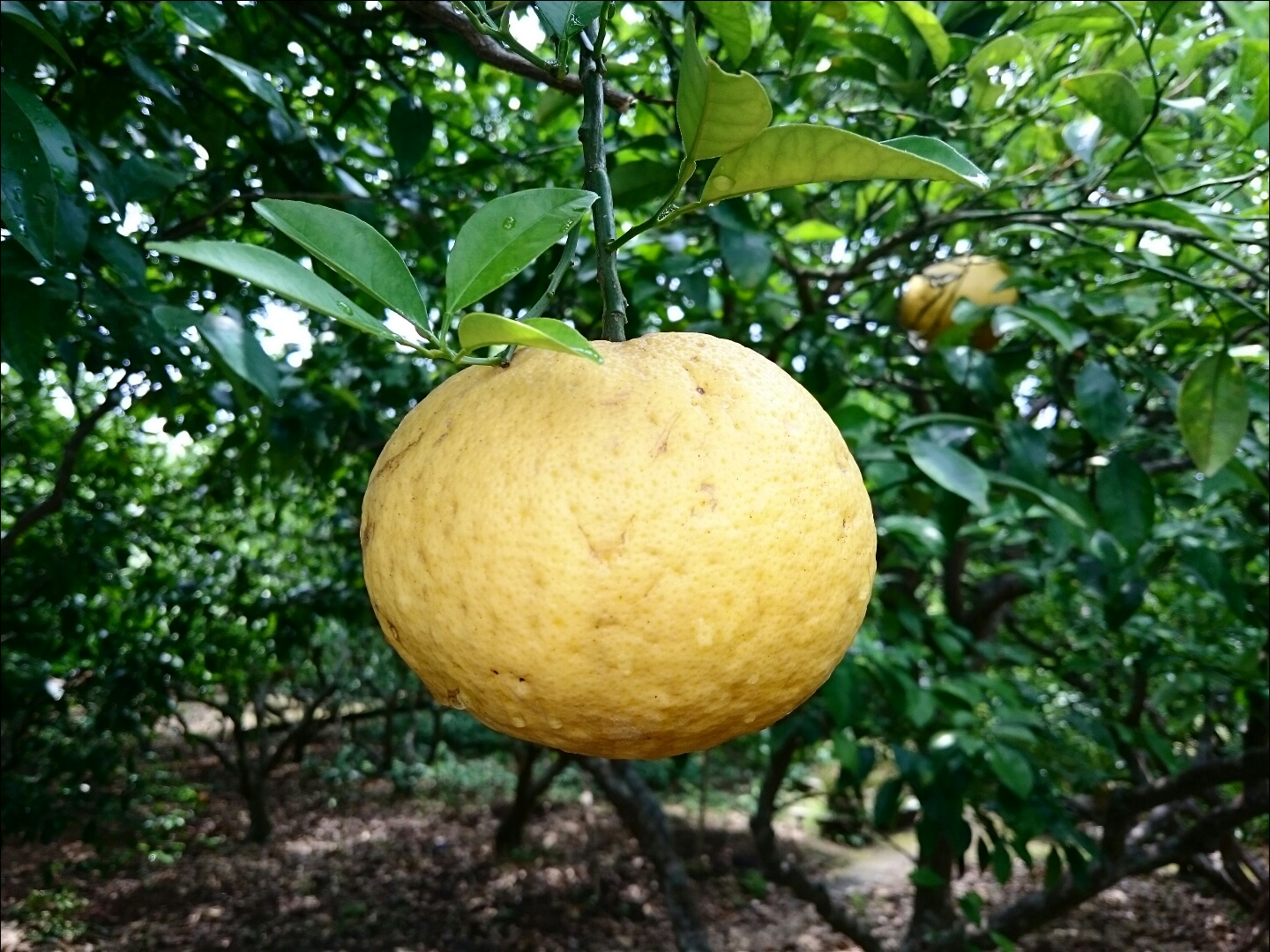
It is cluttered with beautiful old residences and lemon trees and famous for its pottery.
At the moment Hagi is a hidden gem and only chosen very rarely as a travel destination by foreign tourists.
This could soon change however, as Hagi will be used for the setting of an NHK TV drama and thus might gain international appreciation.




a potter at his work

Hagi Castle ruins


SIDE NOTE: I was able to draw out money at a 7/11 in Hagi.

Tuesday, 2 June 2015

Pushed for Money in Shimune

The next stopover on our itinerary was the Shimane Prefecture, where we had planned to spend three days; two in its capital Matsue and one in Izumo.

Travelling westwards from Tottori and following the coastline, we reached Matsue after a three hour train ride.

The first thing we did in Matsue was to locate the next ATM that supported foreign debit cards because I had completely run out of cash.
My card, however, was rejected - just like in Tottori where I had tried to withdraw money the day before at an identical ATM.
Since I knew there wasn't anything wrong with my card (I had contacted my bank right after the incident in Tottori) and Alessio's wasn't working either, we concluded that the problem lay with the ATM.
We thus sought out the help of the only English speaking employee at the tourist information centre and asked him if there were any other available ATMs.
He promptly suggested to take us to the various ATMs personally, an offer we thankfully accepted. Together we ambled through town, trying each and every ATM - without succes.

My next best chance of withdrawing money would be in the 7/11 store in Hagi, which lay two days ahead of us. Until then I would have to rely on my credit card and Alessio's cash reserves.

Having waisted so much time on looking for an ATM, we were left with only a few things to do in the afternoon.
We decided to explore the old part of town and eventually ended up at an old samurai residence.
It was built in 1730 and inhabited by the Shiomi family, a military family of middle rank.
Everything was laid out very nicely and we got a good idea of how a samurai's household might have looked like.


As it was beginning to rain quite heavily (the rain season had just begun) we got on the tourist bus for a trip around town afterwards.

On the next day we visited Matsue Castle, also known as the "black castle" or "plover castle". 


Our rather quirky guide explained us that Matsue Castle was the second largest, the third tallest and the sixth oldest of the only 12 remaining original castles in Japan and the sole remaining in the San-in Region. 
Its construction was carried out over a five year period (1607 - 1611) under the rule of Yoshiharu and was designated for warfare, featuring a lookout floor, wooden paneling, arrow and gunholes, stone dropping holes, among other defensive elements.


the view from the castle's top floor

Some of the exhibited samurai armors:


There were plenty of other interesting stories and myths surrounding the castle which our guide told us with great enthusiasm and passion. I had trouble following her however, since I was already too occupied with making sure she wouldn't fall and hit her head as she stepped over and bumped into every imaginable object around her.
She later confessed that her clumsiness, coupled with her limited English abilities, were the reasons that she was a free guide.


a picture of us with our clumsy, yet very likeable and knowledgeable guide


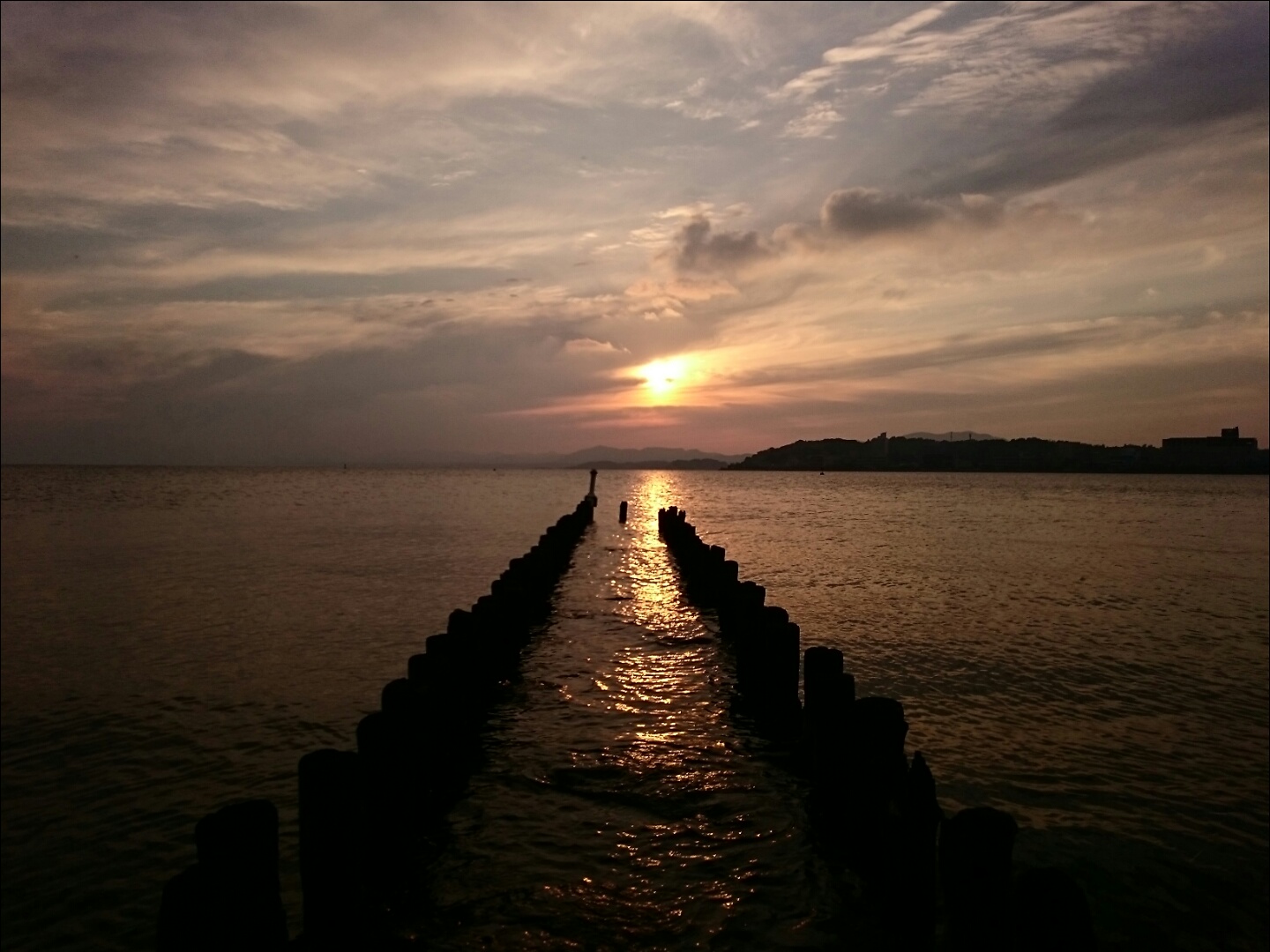
In the late afternoon we went on a boat trip that took us around Shinji Lake and then watched the sun set over Yomegashima Sanctuary Island with a whole crowd of spectators.
Although the conditions weren't the best, there were plenty of people with expensive-looking cameras and tripods trying to get the perfect shot of the sunset.
I tried my best with my smartphone:


the Yomegashima Sanctuary Island 


As there was no cloud in the sky the next day, we chose to rent a set of bikes to explore Izumo.

First we cycled to Izumo-taisha, one of the most important and ancient Shinto Shrines in Japan, dedicated to Ookunishi, the deity of marriage and wealth.
The shrine is mentioned in the Kojiki, the oldest chronicle of Japan, but its exact date of establishment remains yet a mistery.


We then carried on to the Inasa-no-hama Beach, which lies about a kilometre from the shrine and is known as "the playground of myths". According to legend, 8 million gods of Japan leave their home shrines once a year and gather on this beach to discuss the Kakuretaru-shinji (secret rituals) for the coming year, such as marriages, deaths and births.


We didn't have much energy left for discussion and thus lay down to tan for a while before hurrying back to town to hand back our bicycles.

We had supper at a local restaurant where no one of the staff spoke a single word of English whatsoever. 
As no English menu was provided either, we ordered the only dish of which there was a picture, thinking it was a safe call to make.
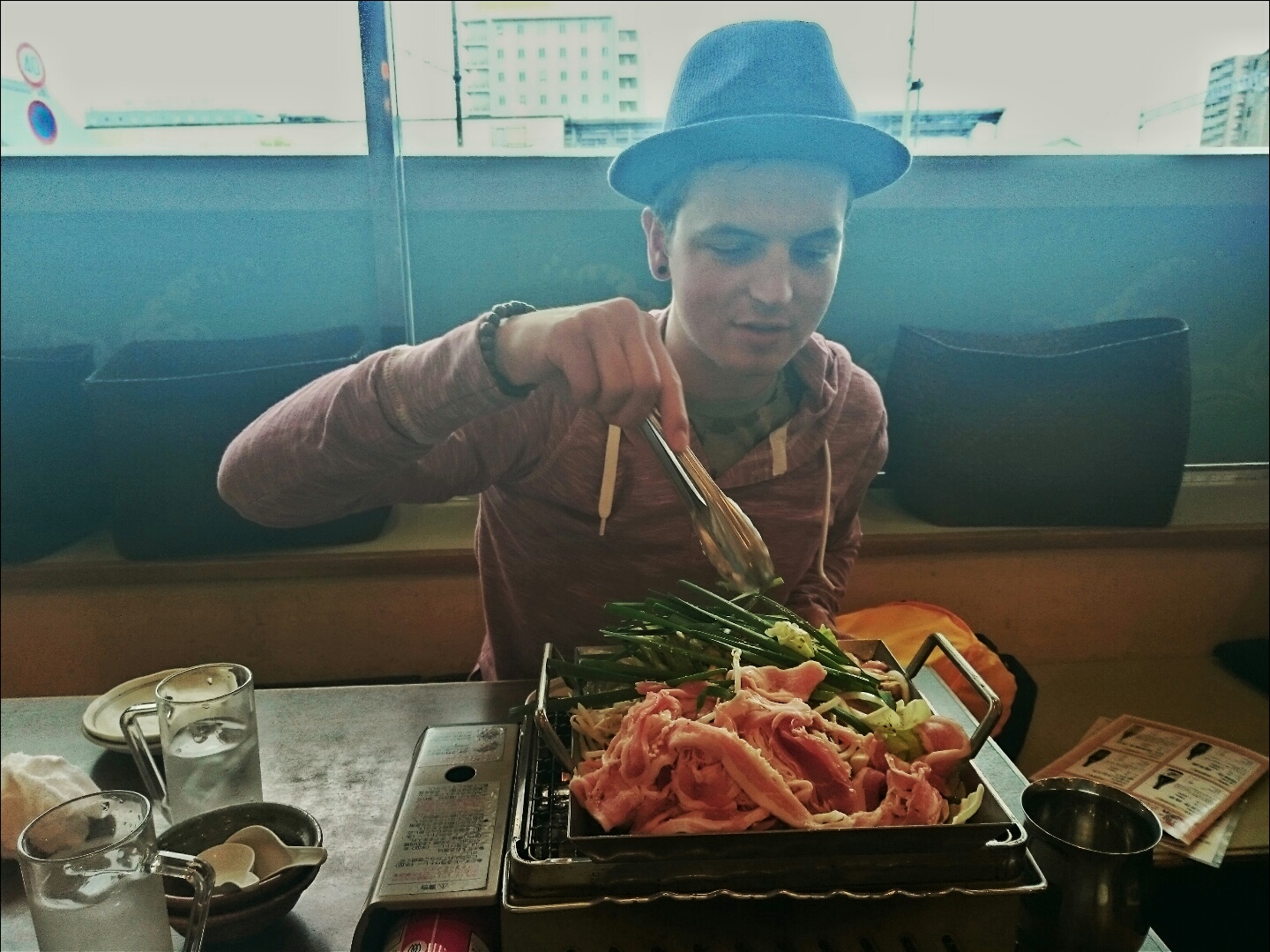
But that didn't mean we weren't surprised by what they eventually brought to our table: a platter of raw ingredients which first had to be cooked over a gas stove!
The instructions on how to operate the stove and cook our food were given to us in form of a Google-translated (meaning utter rubbish) note on the waitresses smartphone. 
Once again it was time to improvise and we eventually managed to prepare our supper without dying of hunger in the process nor suffering from food poisoning in the aftermath, although we did get laughed at by the other guests quite a lot.


Saturday, 30 May 2015

The Desert and the Deserted City

For our stay in Tottori we had decided to do some outdoor activities.
Not that we had much of a choice, as there actually isn't much else to do there.

Situated on the northern coast of the Chuugoku region, Tottori prefecture is the least populous prefecture of Japan. This makes itself apparent in its capital, Tottori city. Juxtaposed to Tokyo, the buildings are low, old, rusty and many of them seem to be in a state of disuse and decay.
At day there are hardly any people to be seen on the streets and the main venue in the evening appears to be a Starbucks, from where I'm writing this post.


Tottori at dusk

The biggest tourist attractions in Tottori are the sand dunes, located on the town's north-eastern shore, and a sand museum which lies adjacent to them.

That's where we went on the first day of our stay to take a beginner's course in paragliding.
After a rather awkward and somewhat clumsy reception of our instructors we packed our gear and headed out to the sand dunes. We did feel a little hesitant after the ambiguous, patchy and bewildering briefing of the instructors, uttered in an improvised Jenglisch. Being the men we are however, we didn't let that unsettle us too much and by using our colourful imagination we filled the gaps, added the essential details and took off.

And what an exciting and exhilarating experience it was! Indeed, the flights usually didn't last for more than half a minute, but they were surely long enough to give me a nice kick of adrenaline and make me crave for more...

I filmed one of Alessio's take-offs and all of my flights on the GoPro camera Alan had lent me (thanks Alan!) but I don't think I'll be able to upload the videos to the blog, as the file sizes are too large and we have no means of compressing them. Sorry guys :-(.


this was the approximate location for take-off


Afterwards we went to the sand museum where a Germany-themed exhibition was being held.
The sculptures were awe-inspiring and the amount of detail simply amazing.
Convince yourself and take a look at the pictures! Can you guess what the different sculptures depict?


- Louis

As mentioned beforehand, we discussed on outdoor activities in Tottori. So we decided to go kayaking on our second day in Tottori. Immediately after arriving at the meeting point for the kayaking, we were welcomed by our guide Takaharu, who would accompany us on our little adventure. We very pleasently surprised and delighted by our guide's English skill. He spoke a very good English with almost no accent, which is very uncommon for Japanese people, especially in rural areas (remember our guides for the paragliding). After a short introduction we headed to the port, where we put out to see. After having gotten out of the port the beautiful and pristine nature welcomed us. We steered or kayak through caves and around peculiarly shaped rock formations. We indulged ourselves in the calm and relaxing atmosphere created by the sea and our surroundings. We both relished the kayaking a lot and would recommend it to anyone who is planning to visit Tottori. 

Our thanks goes to our guide Takaharu for taking the following pictures.


We decided to have dinner at a close seafood restaurant, which according to our kayaking guide, should have been the best seafood restaurant in the area. Unfortunately we didn't get the chance to find out for ourselves, as the restaurant was already fully reserved when we arrived at 17:00. We spent the evening at Starbucks (again), since it seems to be the only place in all Tottori, where there are actually people. Now we are heading to Matsue, where we will spend the next two nights, posts about Matsue will follow.

- Alessio